
Home / Services / Google Nest thermostats
Google Nest thermostats for San Diego County homes
Precision Air Inc installs and sets up Google Nest thermostats on air conditioners, furnaces, heat pumps and zoned systems across San Diego County. We confirm compatibility, wiring and settings at a design consultation, paid at the visit and credited toward your job if you go ahead.
Current Nest models we install
Google currently lists two Nest thermostats. We install and service both. We are not a Google Nest Pro or Google partner; we install and set up the equipment for the systems we service.
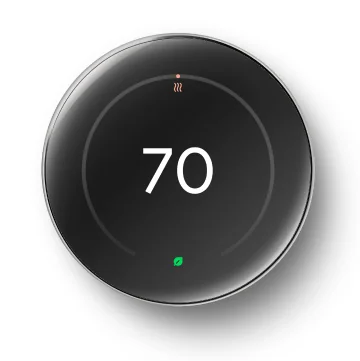
Nest Learning Thermostat (4th gen)
This is Google's current Learning Thermostat. Official specifications say it works with most 24-volt systems, including gas, electric, oil, forced air, heat pump and radiant, and that it can control up to three stages of heat and three stages of cool, heat pumps with auxiliary and backup heat, and the fan. A Nest Temperature Sensor (2nd gen) is included in the box. It is set up in the Google Home app.
Nest Thermostat
Google's lower-featured current model. Official comparison copy states that it works with 85 percent of systems, and that some systems, including heating-only, cooling-only, zone-controlled and heat pump systems, require a C-wire or a Nest Power Connector. It is not compatible with the Nest Temperature Sensor. We recommend it only when it fits the equipment after we check the wiring.
Model choice depends on the furnace, air conditioner or heat pump, the number of stages, and whether the thermostat will run a whole system or a single zone. We confirm that at the consultation. No equipment prices are listed on this page.
Heat pumps, dual fuel and two-stage systems
The Nest Learning Thermostat (4th gen) is specified for heat pumps and for multi-stage conventional systems. Dual-fuel systems (a heat pump paired with a gas furnace) and two-stage equipment need the correct accessory and staging settings so the thermostat does not fight the equipment. We set those during installation and run the system to confirm the calls.
Zoned systems
Google's published guidance says Nest thermostats are usually compatible with zoned systems that use multiple thermostats and a zone panel, including damper zoning, when the wiring is standard. They are not a fit for systems in which the thermostat itself opens and closes dampers through proprietary terminals. On the Honeywell TrueZONE HZ432 panel we install, the panel operates the dampers and stages the equipment, so each Nest used as a zone thermostat is typically configured for single-stage heat and cool. Power on a zoned system is also a factor: if a Nest Power Connector is required, Google states that one is needed for each thermostat on that system.
For the panel, dampers and a starting design, see our zoning systems page.
C-wire and power
The Nest Learning Thermostat (4th gen) can take power from the heating and cooling wires (Power Sharing) and, according to Google, does not need a C-wire in most homes. In limited cases a C-wire or Nest Power Connector is still required to keep the thermostat powered without affecting the equipment. The Nest Thermostat is more likely to need a C-wire or Power Connector, especially on heat pump or zoned systems. We test the existing wiring and add a common or a Power Connector when the system needs one.
Why professional installation matters
A smart thermostat is only as good as the wiring and the equipment settings behind it. Heat pump O/B (reversing valve) terminals, auxiliary heat, dual-fuel changeover, staging, the fan, and zone-panel inputs all have to be identified and configured correctly. On a zoned system the thermostat should not be set as if it were running the equipment's stages by itself. We install the thermostat, connect power correctly, complete setup in the Google Home app with you, and verify the calls at the indoor unit or zone panel.
We also install ecobee thermostats.
We install and service systems for homes across San Diego County, including Encinitas, Carlsbad, Oceanside, Vista, San Marcos, Escondido, Poway, Del Mar, Solana Beach, Rancho Santa Fe, La Jolla, Ramona and 4S Ranch.
Questions about Google Nest thermostats
Which Google Nest thermostats do you install?
Current Nest models we install include the Nest Learning Thermostat (4th gen) and the Nest Thermostat. We confirm which model fits your equipment at a design consultation, paid at the visit and credited toward your job if you go ahead.
Will a Nest thermostat work with a heat pump or a dual-fuel system?
The Nest Learning Thermostat (4th gen) is specified by Google for most 24-volt systems, including heat pumps (up to three compressor stages, with auxiliary and backup heat) and multi-stage conventional heating and cooling. Dual-fuel setups and unusual wiring are confirmed at the visit. The Nest Thermostat works with a smaller share of systems; Google states that some heat pump systems need a C-wire or a Nest Power Connector.
Can a Nest thermostat be used on a zoned system?
Google's support guidance says Nest thermostats are usually compatible with zoned systems that use multiple thermostats and zone panels, including damper zoning, when the system uses standard thermostat wiring. They are not compatible with setups where the thermostat itself drives the dampers through proprietary terminals. On a Honeywell TrueZONE HZ432 panel, the panel controls the dampers and the equipment staging, so a Nest used as a zone thermostat is typically set for single-stage heat and cool. See our zoning systems page for how that panel works.
Does a Nest thermostat need a C-wire?
The Nest Learning Thermostat (4th gen) is designed to work in most homes without a common (C) wire by using Power Sharing. Google notes that in limited cases a C-wire or a Nest Power Connector is still required, and that a Power Connector, when used on a zoned system, is needed for each thermostat. For the Nest Thermostat, Google states that some systems, including heating-only, cooling-only, zone-controlled and heat pump systems, require a C-wire or a Nest Power Connector. We check the wiring at the visit.
Why have a professional install a Nest thermostat?
A Nest thermostat has to be wired and configured for the actual equipment: heat pump reversing-valve settings, auxiliary or backup heat, dual fuel, staging, fan, and any accessories. On a zoned system the zone panel, not the thermostat, usually handles staging and damper control, so the setup has to match that. Incorrect wiring or settings can leave the system short-cycling, stuck in the wrong mode, or under-powered. We install and set it up, then confirm it calls the equipment the way it should.
What are your office hours?
Monday through Friday, 8 am to 5 pm. After hours, our answering service takes your message and our office follows up the next business day.
Request a design consultation
The fee is paid at the visit and credited toward the job if you go ahead. Our office calls during business hours, Monday–Friday 8–5, to schedule. At the visit we confirm the model, wiring and settings for your system.
Ready to talk about your heating or cooling?
Office hours Monday–Friday, 8 am–5 pm. After hours, our answering service takes your message and our office follows up the next business day.