Home / Services / Refrigerant leak detection

Refrigerant leak detection for San Diego County homes

When an air conditioner or heat pump is low on refrigerant, adding a charge without finding the leak is not a repair. Precision Air Inc recovers the refrigerant, pressure-tests the system, and uses more than one detection method when needed to locate the leak before we repair or replace the failing part.

How we look for a refrigerant leak

A low charge, a hiss, oil at a joint, or a system that cools for a while and then falls off can all point to a leak. The work starts with recovering the refrigerant so the system can be opened or tested without releasing it to the atmosphere. Section 608 of the Clean Air Act and EPA rules in 40 CFR Part 82, Subpart F require that regulated refrigerant be recovered with certified equipment before an appliance is opened, and they prohibit venting that refrigerant.

We then use a structured set of tests. A standing pressure test can confirm that the system is leaking. Electronic detectors, bubble solution, ultrasonic listening, and, when appropriate, ultraviolet dye are how we locate the spot. The method we lead with depends on the equipment, where we suspect the leak, and whether the leak is large, intermittent, or hidden.

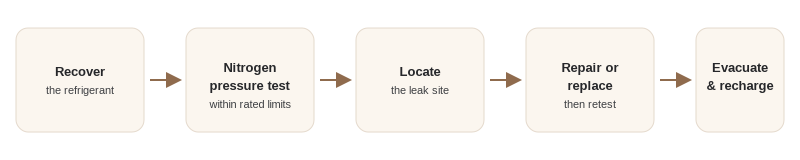
Process diagram: recover refrigerant, nitrogen pressure test, locate the leak, repair or replace the part, then evacuate and recharge
A typical leak-search sequence. Some leaks need more than one method, and dye inspection may need a return visit.

High-pressure leak checks with dry nitrogen

For a high-pressure leak check we recover the refrigerant, then pressurize the isolated section with dry nitrogen. Electronic refrigerant detectors do not sense nitrogen alone, so this charge is often given a small amount (a trace) of the system's refrigerant so a detector can pick it up. Pressure is raised through a regulator, with a relief valve on the nitrogen supply, and only to a test pressure within the manufacturer's rated limits for that equipment. We do not exceed the rated test pressure or the ratings of hoses, gauges and fittings just because a leak has not yet appeared.

Once the test pressure is reached, we isolate the nitrogen supply, record the pressure and the ambient temperature, and watch for a drop. That standing pressure, or decay, test shows whether the isolated section is tight. A drop in pressure can be a leak; temperature also affects pressure, so we account for that when we read the gauges. If the section does not hold, we move to methods that can pinpoint the location. A nitrogen-and-refrigerant mixture is recovered after the test; it is not vented.

Why small leaks are hard to find

Not every leak is a loose fitting you can see or hear. Some open only when the tubing is hot or cold, or when the compressor is running and the lines are vibrating, and then close up when the system is off and the metal contracts. A leak can be inside the evaporator coil, in a tight coil cabinet, or on a line set inside a wall, ceiling or slab, where a detector cannot reach until we know which section to open.

Formicary corrosion is a documented cause of pinhole leaks in copper evaporator tubing. It forms a network of microscopic tunnels in the tube wall, named for their resemblance to an ant nest, and is associated with copper, moisture, oxygen and organic acids. Those pinholes are often not obvious in a visual check, which is why a pressure test and a careful detector search matter on indoor coils.

Coastal air is corrosive to outdoor coils and exposed copper, driven by salt in sea spray, mist and fog. That matters in coastal North County cities such as Encinitas, Carlsbad, Del Mar, Solana Beach, Cardiff-by-the-Sea, La Jolla and Oceanside, where outdoor coils and line sets see that exposure. We look at both the indoor coil and the outdoor unit and lines when we search a coastal system.

Test methods we use

EPA guidance for leak inspections lists methods that can locate a leak, including electronic leak detectors used according to their manufacturer guidelines, bubble tests and ultrasonic tests. A standing pressure test can show that a leak exists, but it does not by itself mark the spot, so we use it together with a locating method.

Electronic leak detectors

Probe-type electronic detectors used in this work commonly use a heated-diode sensor or an infrared sensor. They respond to refrigerant in the air around a joint, coil or line. We use them after a nitrogen-and-trace-refrigerant pressure test, or on a charged system when that is the safer path, and we follow the detector manufacturer's operating instructions.

Bubble solution

A bubble, or soap, solution on a joint, valve, or accessible length of tubing can show a leak as it forms bubbles under pressure. It is most useful on fittings and other spots we can reach and see. It does not help much inside a coil or behind a wall.

Nitrogen pressure decay

A standing pressure test on an isolated section, as described above, tells us whether that section holds. If it does not, we narrow the search to that section and then use a locating method to find the opening.

Ultrasonic

An ultrasonic detector listens for the high-frequency sound of gas escaping under pressure. It can help when a leak is large enough to make that sound and when electronic detection is inconclusive. It still needs a clear path to the leak site.

UV dye and UV light

A fluorescent dye is injected into the system and circulates with the oil and refrigerant. We then inspect joints, coils and accessible lines with an ultraviolet light. The dye may need time to travel, so a return visit is sometimes required before a leak shows. We use only dye approved by the equipment or compressor manufacturer, at the recommended concentration, because unapproved additives can affect equipment warranties.

After a leak is found

Once we have a location, we recover any remaining test charge, make the repair, and retest that section before we evacuate the system to a deep vacuum and recharge it to the manufacturer's specified charge. A leak at a brazed joint, service valve or fitting can often be repaired in place. A leak in the coil itself, including pinholes from formicary corrosion, often means replacing the evaporator or condenser coil rather than attempting a temporary patch.

We review the manufacturer's warranty documents with you before we recommend repair or replacement. Remaining parts coverage, if any, depends on those terms and on how the equipment has been serviced, including whether only approved additives were used.

If the system also needs a broader repair or a replacement, see our air conditioning and heat pump service pages, or start with a system estimate.

Homeowner financing available, subject to credit approval.

Questions about refrigerant leak detection

What is a nitrogen pressure or decay test?

After the refrigerant is recovered, we pressurize the isolated section with dry nitrogen, often with a small amount of the system's refrigerant so an electronic detector can sense it, to a test pressure within the manufacturer's rated limits. We then isolate that charge, record pressure and temperature, and watch for a drop (a standing pressure, or decay, test). Nitrogen is applied through a regulator and relief valve. We do not vent a nitrogen-and-refrigerant mixture; it is recovered after the test.

Why are small refrigerant leaks hard to find?

Some leaks only show up under certain temperatures or when the system is vibrating. Others are inside the evaporator coil, inside a cabinet, or on a line set buried in a wall or ceiling. Formicary corrosion can open pinholes in copper evaporator tubing that are not obvious to the eye. A pressure test can show that a leak exists before a detector pinpoints where it is, and some methods need more than one visit.

Do you use UV dye to find leaks?

When it is the right method, yes, and only with dye approved by the equipment or compressor manufacturer, used at the recommended concentration. The dye circulates with the oil and refrigerant. It is then inspected with ultraviolet light. It may need run time, and sometimes a return visit, before a leak shows clearly.

If you find a leak in the coil, do you repair it or replace the coil?

It depends on where the leak is and whether a lasting repair is practical. A leak at a joint or fitting can often be repaired. A leak in the coil itself, including leaks from formicary corrosion, often means replacing the coil. We also review the manufacturer's warranty terms with you before we recommend a path, then evacuate and recharge the system after the work.

Do you offer refrigerant leak detection in coastal North County?

Yes. We perform leak detection on air conditioners and heat pumps across San Diego County, including Encinitas, Carlsbad, Del Mar, Solana Beach, Cardiff-by-the-Sea, La Jolla, Oceanside and inland cities. Coastal air is corrosive to outdoor coils and exposed copper, which is one reason we look carefully at those systems.

What are your office hours?

Monday through Friday, 8 am to 5 pm. After hours, our answering service takes your message and our office follows up the next business day.

Ready to talk about your heating or cooling?

Office hours Monday–Friday, 8 am–5 pm. After hours, our answering service takes your message and our office follows up the next business day.

Request service

This site is protected by hCaptcha and its Privacy Policy and Terms of Service apply.

We use your details only to reply to this request. We don't sell them or add you to marketing lists. See our privacy policy. We reply during business hours, Monday–Friday 8–5.

Call (760) 858-8000